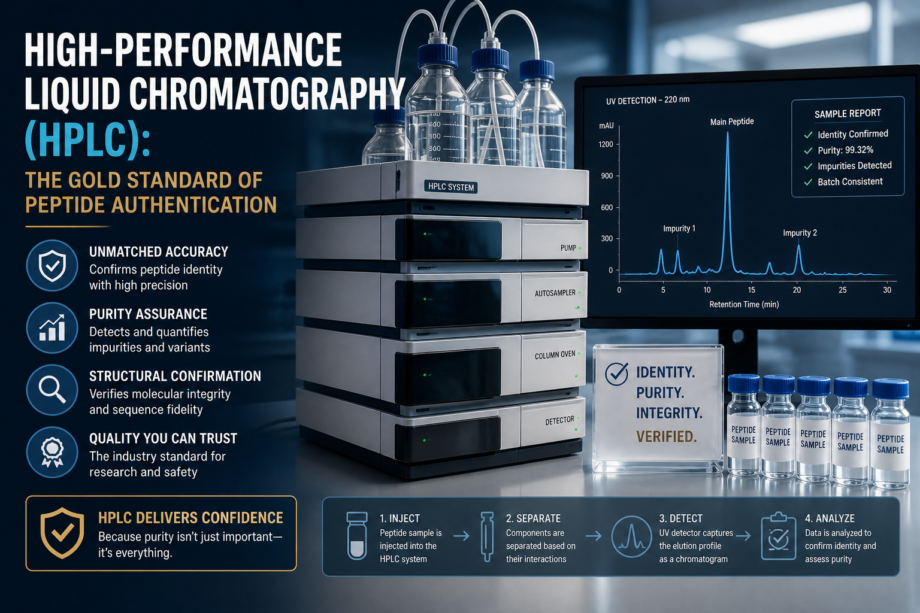
Introduction to Analytical VerificationIn the landscape of laboratory research, the purity of a reagent is not a luxury—it is a foundational requirement. High-Performance Liquid Chromatography (HPLC) is the analytical chemistry technique used to separate, identify, and quantify each component in a peptide mixture. At InnovaLab, we prioritize HPLC data to ensure that research outcomes are not compromised by synthesis byproducts or residual TFA (Trifluoroacetic acid).Technical ProcessHPLC works by passing a pressurized liquid solvent containing the peptide through a column filled with a solid adsorbent material. Each component in the sample interacts slightly differently with the adsorbent material, causing different flow rates for the different components and leading to the separation of the components as they flow out of the column.Mass Spectrometry (MS) Correlation: While HPLC confirms purity, MS confirms the identity of the molecule by measuring the mass-to-charge ratio of the ions.Purity Thresholds: For reliable research, a purity of \ge 99\% is the benchmark. Anything less introduces “noise” into the data, potentially leading to false-positive results in metabolic signaling assays.ReferencesAguilar, M. I. (2004). HPLC of Peptides and Proteins: Methods and Protocols. Methods in Molecular Biology.Hearn, M. T. (1991). HPLC of Peptides, Proteins and Polynucleotides. VCH Publishers.
High-Performance Liquid Chromatography (HPLC): The Gold Standard of Peptide Authentication