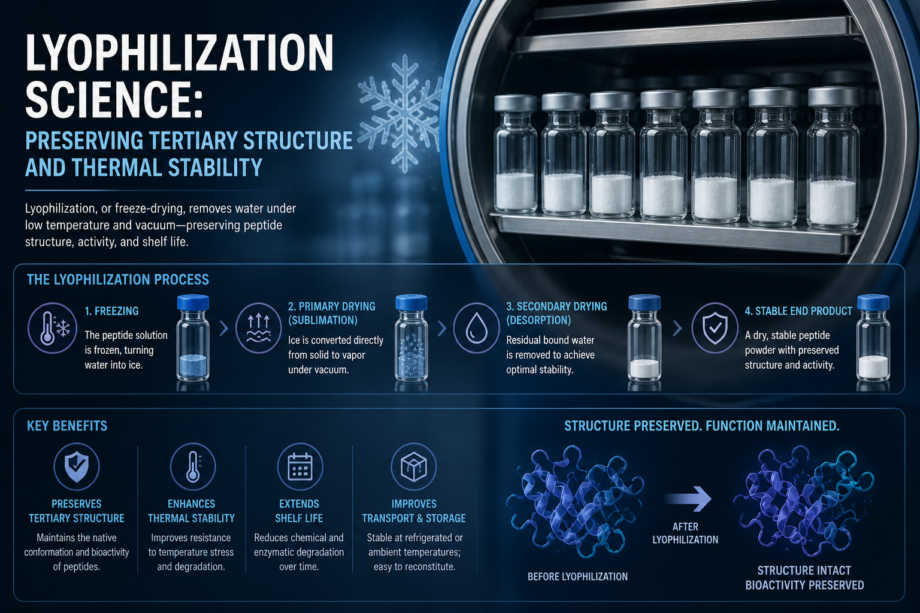
The Physics of Freeze-DryingPeptides are inherently fragile chains of amino acids. In an aqueous (liquid) state, they are subject to hydrolysis and deamidation, which leads to rapid degradation. Lyophilization, or freeze-drying, is the process of removing water through sublimation—converting ice directly into vapor without passing through the liquid phase.The Two-Stage ProcessPrimary Drying (Sublimation): Under a vacuum, the pressure is lowered, and enough heat is added to the ice to allow it to sublimate.Secondary Drying (Desorption): The temperature is raised slightly to remove any unfrozen water molecules bound to the peptide surface, achieving a residual moisture level of < 5\%.Storage and Reconstitution ImpactsLyophilized peptides exist in a “glassy” state, which prevents the molecules from colliding and reacting. However, exposure to UV light or temperatures exceeding 25°C can still cause thermal degradation. This is why “cold-chain” logistics are vital for maintaining the integrity of molecules like Retatrutide during transit.ReferencesTang, X., & Pikal, M. J. (2004). Design of Freeze-Drying Processes for Pharmaceuticals: Practical Advice. Pharmaceutical Research.Wang, W. (2000). Lyophilization and development of solid protein pharmaceuticals. International Journal of Pharmaceutics.
Lyophilization Science: Preserving Tertiary Structure and Thermal Stability