
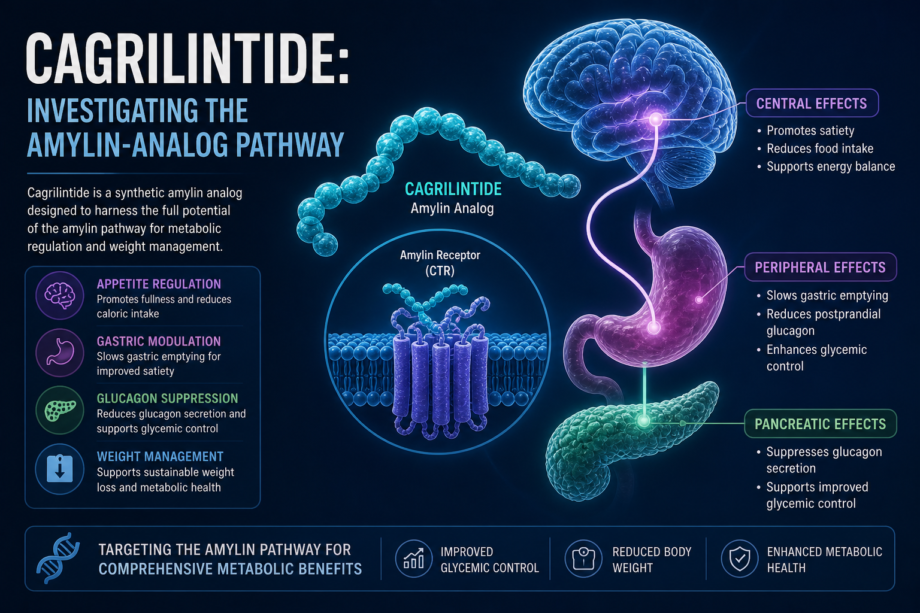
Non-Incretin Mechanisms in Metabolic ResearchWhile the scientific community has focused heavily on incretins (GLP-1/GIP), Cagrilintide introduces a different pathway: the Amylin receptor. Amylin is a 37-amino acid peptide hormone co-secreted with insulin. Cagrilintide is a long-acting acylated analog designed to overcome the rapid clearance of endogenous amylin.Dual-Targeting: The Hindbrain ConnectionUnlike GLP-1, which heavily influences the hypothalamus, amylin analogs like Cagrilintide have potent effects on the Area Postrema (AP) and the Nucleus Tractus Solitarius (NTS) in the hindbrain.Satiety Modulation: It signals a “fullness” sensation that is independent of the gut-slowing effects of GLP-1.Glucagon Suppression: It works to suppress postprandial glucagon secretion, which is vital for studying glucose homeostasis in insulin-resistant models.The Synergy HypothesisCurrent research is focused on the additive effects of combining Cagrilintide with Semaglutide. Because they target different areas of the brain and different hormonal pathways (incretin vs. amylin), they appear to work synergistically rather than competitively, providing a more robust metabolic response in research subjects.
ReferencesFrias, J. P., et al. (2021). Cagrilintide plus semaglutide 2·4 mg in adults with overweight or obesity: a multicentre, randomised, double-blind, placebo-controlled, phase 1b trial. The Lancet.Kruse, T., et al. (2021). The Designer Amylin Analog Cagrilintide. Journal of Medicinal Chemistry.