
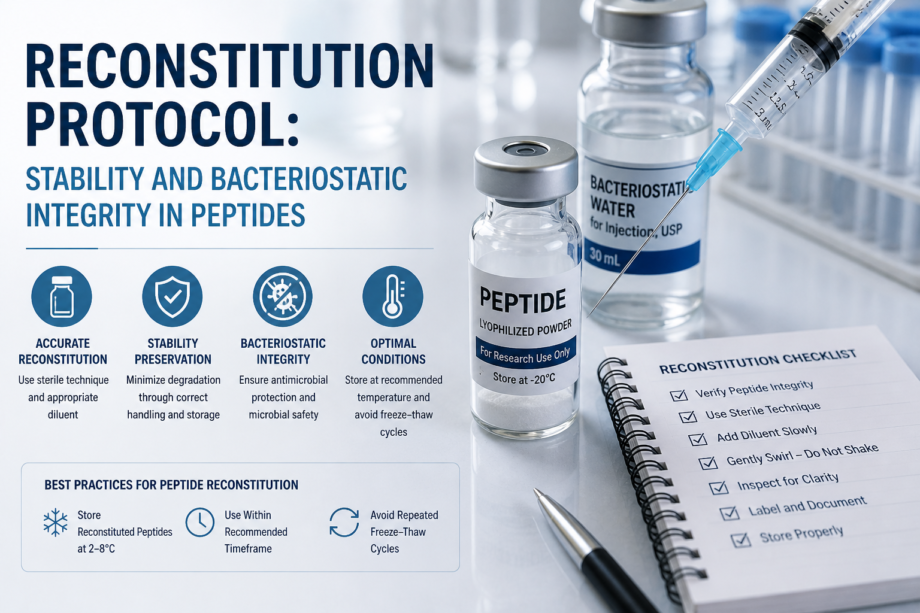
The Thermodynamics of Peptide SolubilizationPeptides are shipped in a lyophilized (solid) state to maximize shelf-life. However, the process of returning them to an aqueous state for laboratory analysis—reconstitution—is a fragile procedure. The secondary and tertiary structures of the peptide can be disrupted by mechanical stress or rapid pH changes.The Role of Bacteriostatic SolventsUsing Bacteriostatic Water (0.9% Benzyl Alcohol) is essential for multi-dose vials. The benzyl alcohol acts as a bacteriostat, inhibiting the metabolic processes of potential contaminants.pH Considerations: Most peptides are stable at a slightly acidic to neutral pH. Bacteriostatic water provides a stable environment, whereas deionized water may lead to rapid deamidation.Mechanical Degradation: Research peptides are susceptible to “shearing.” High-pressure injection of the solvent directly onto the lyophilized cake can break the delicate disulfide bonds within the peptide chain.Optimal Storage ParametersPost-reconstitution, the “clock” begins on peptide hydrolysis. Storage at 2–8°C is mandatory to reduce the kinetic energy of the molecules, thereby slowing the rate of degradation. For longer-term stability study, avoiding “freeze-thaw” cycles is paramount, as the formation of ice crystals can physically shred the peptide structure.
ReferencesCarpenter, J. F., et al. (2002). Rational Design of Stable Protein Formulations. Pharmaceutical Biotechnology.Franks, F. (1998). Freeze-drying of bioproducts: putting theory into practice. European Journal of Pharmaceutics and Biopharmaceutics.